A · Guitar
- Opinion
- “Give the chorus more lift. I would play a little faster.”
- Keep
- “Keep the acoustic guitar up front.”
Two musicians describe what they want to change and keep. The studio turns those priorities into three audio sketches they can compare before rehearsal.
Enter your ideas Hear guitar and pianoInteractive studio
Fill in both perspectives or load the example. Review the translated cues, compare both sides and the blend, then render and download your WAVs. Your ideas and audio stay in this browser.
Open the hosted site or serve this folder over HTTP to render audio. The finished examples below also play from this file.
Choose guitar, piano, or both. The browser renderer uses a shared score and follows supported tempo and level cues. Try adding “110 BPM” or “gentle” to a draft.
Input · Illustrative rehearsal
The musicians enter an opinion and one priority to preserve.
Process
Local rules suggest English music cues for tempo, rhythm, instruments, and texture. The reviewed cues for this case are shown below.
Keep a steady tempo and a clear piano line. Let the fingerpicked guitar provide the rhythmic accents.
The website assembles browser audio from sampled guitar and piano, following the chosen parts, tempo and level. Sampled instruments make plucked attacks and sustained notes easier to compare. The local Riffusion experiment generates a spectrogram from a prompt and reconstructs it as audio.
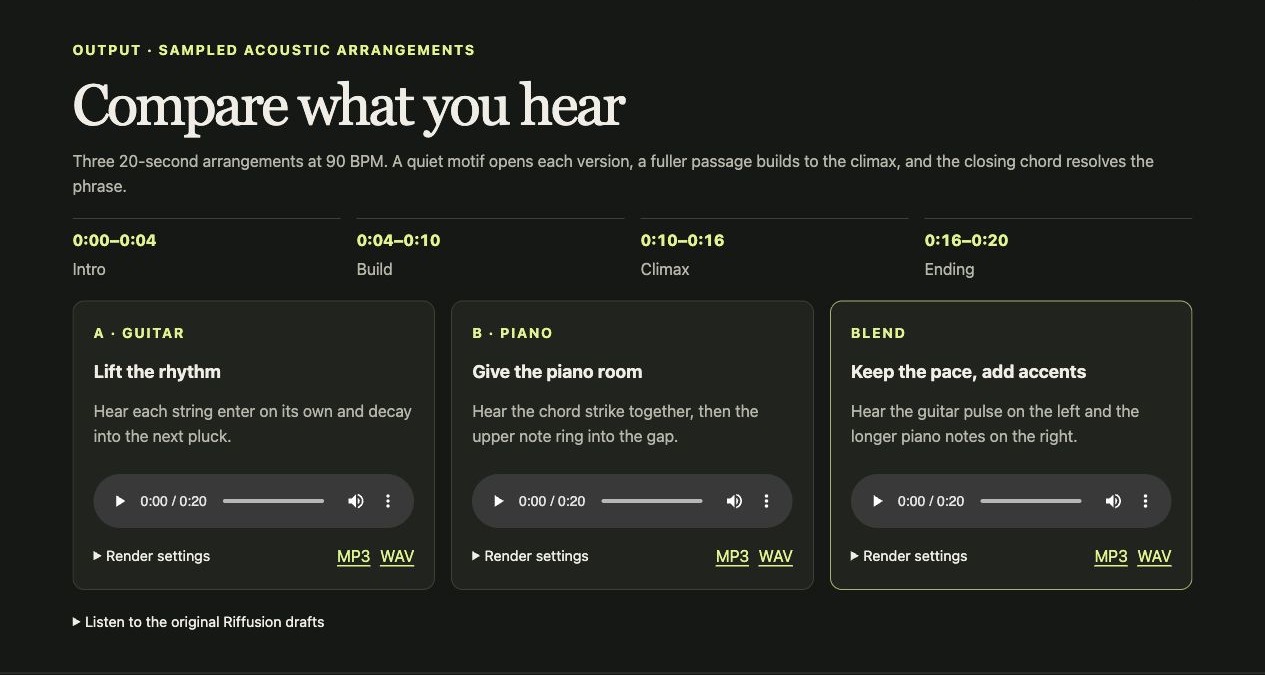
Output · Sampled acoustic arrangements
Three 20-second arrangements at 90 BPM. A quiet motif opens each version, a fuller passage builds to the climax, and the closing chord resolves the phrase.
A · Guitar
Hear each string enter on its own and decay into the next pluck.
B · Piano
Hear the chord strike together, then the upper note ring into the gap.
Blend
Hear the guitar pulse on the left and the longer piano notes on the right.
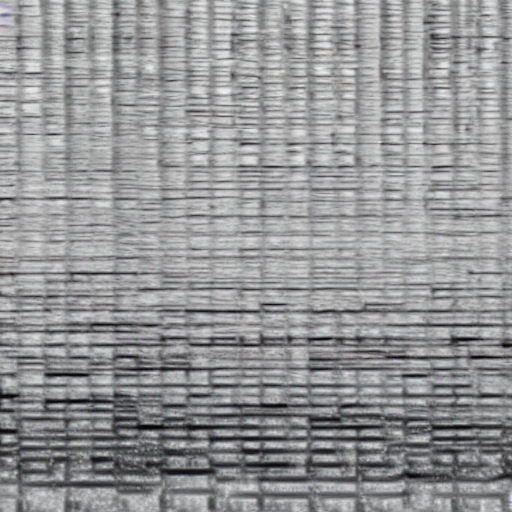
These are the raw model’s arrangements after audio reconstruction. The prompts guide musical character and instrumentation.
clean acoustic folk instrumental, close studio recording, lively tempo, light syncopated hand percussion, fingerpicked acoustic guitar
clean acoustic folk instrumental, close studio recording, steady moderate tempo, spacious felt piano melody, quiet fingerpicked acoustic guitar
clean acoustic folk instrumental, close studio recording, steady moderate tempo, light syncopated hand percussion, fingerpicked acoustic guitar, spacious felt piano melody
Prototype walkthrough
These captures show the earlier local prototype. Try the browser studio above to create your own versions from the shared score.
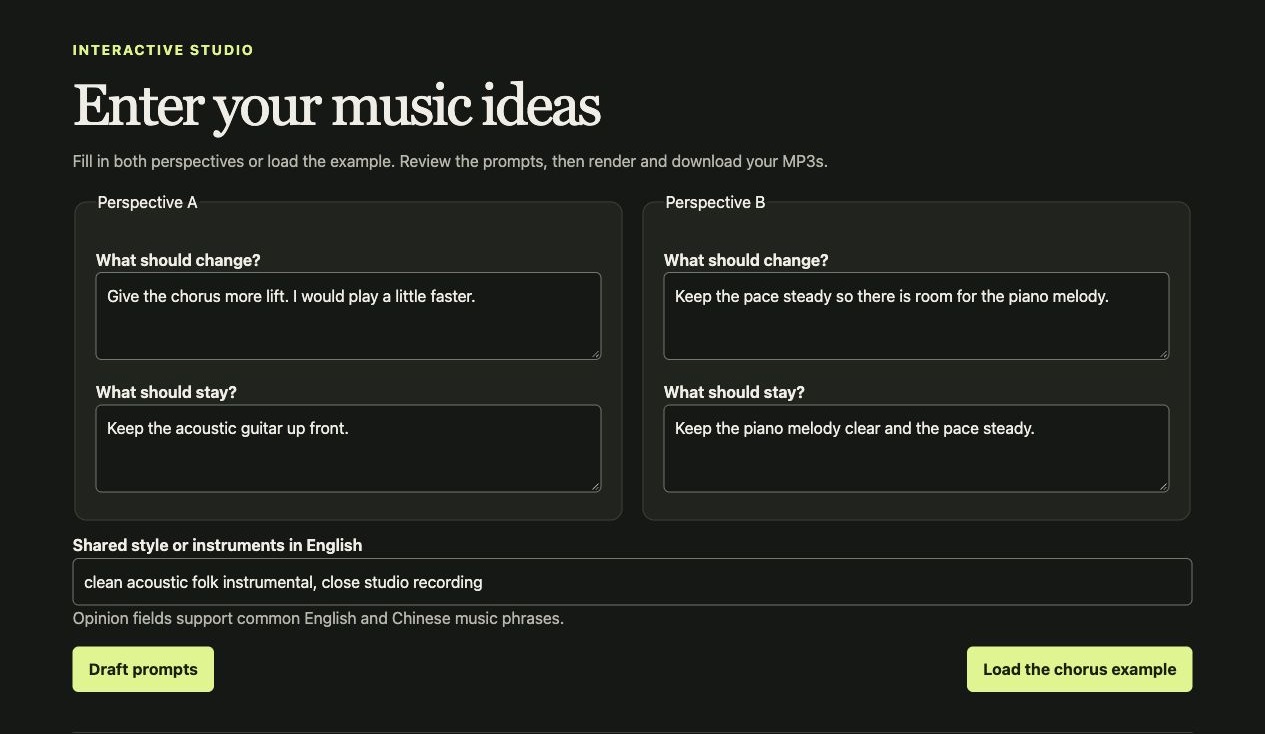
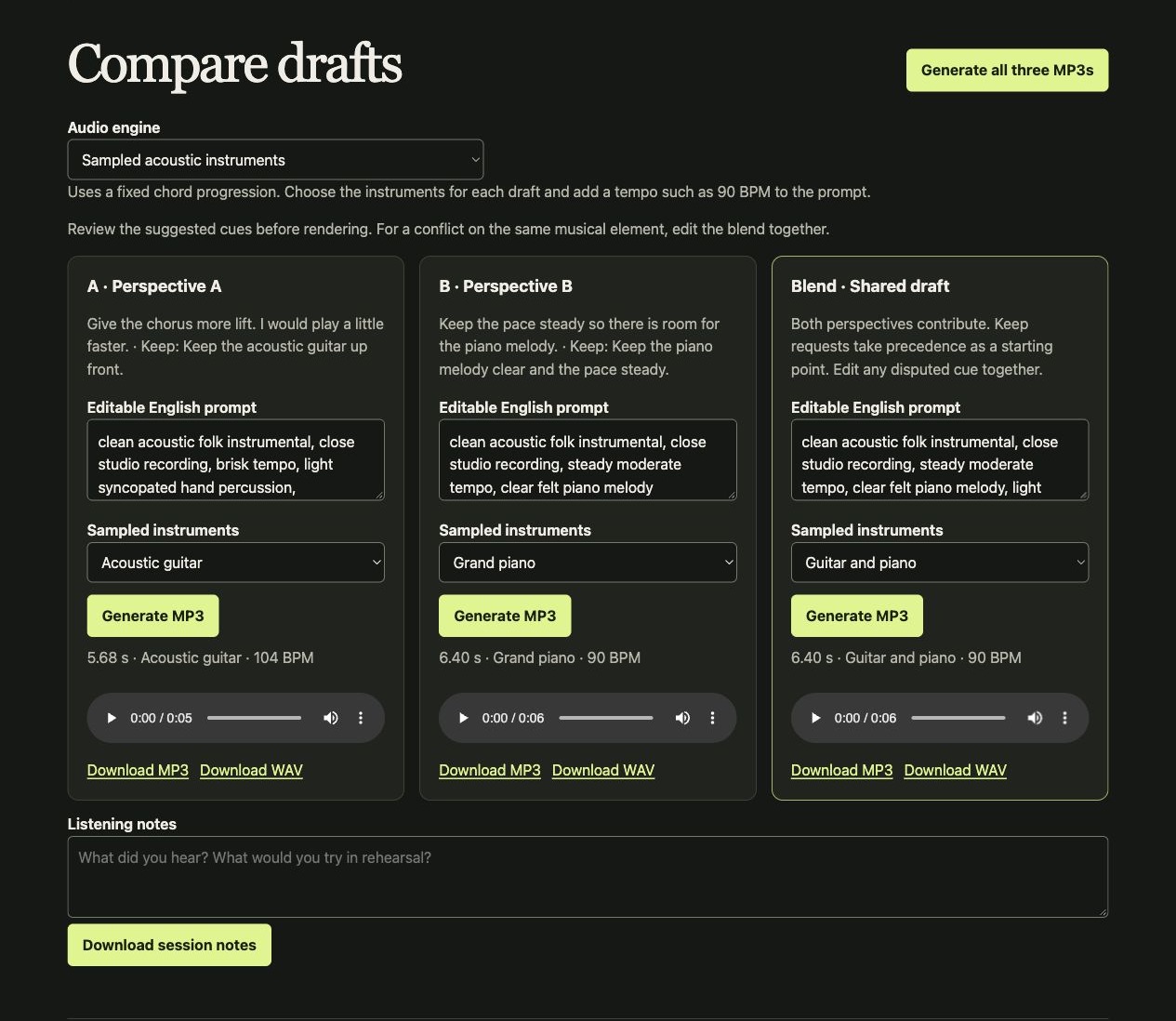
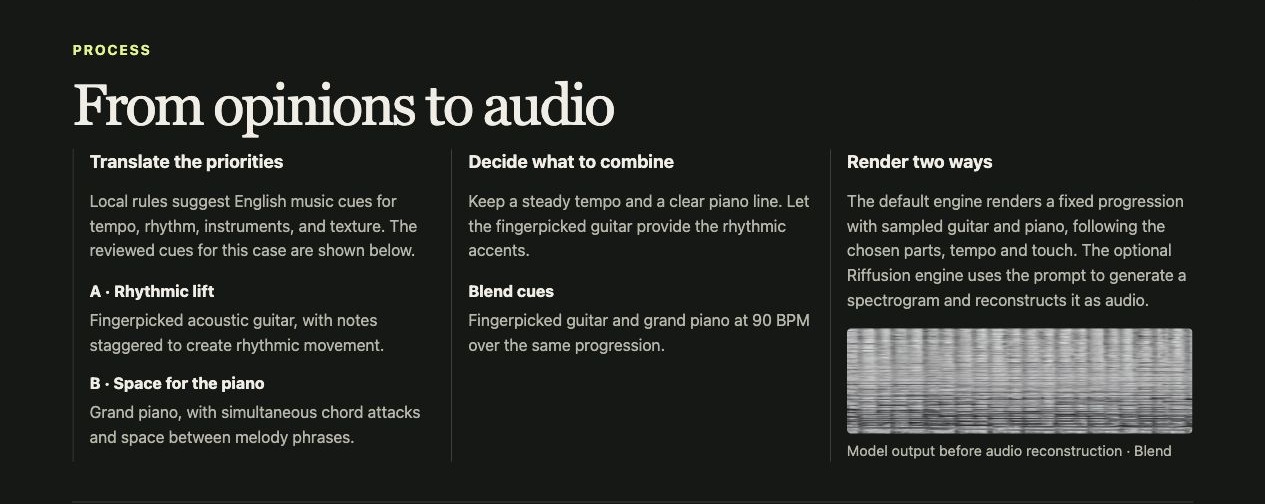
In early Riffusion drafts, the guitar and piano were difficult to distinguish. The prototype added a sampled rendering path, then used the same instruments in a 20-second score so listeners could compare both tone and phrasing.
The rehearsal is illustrative. The browser studio supports two viewpoints and three exports. The sample renderer follows selected instruments, tempo and level over a fixed progression. The local Riffusion experiment explores the full prompt. This prototype was developed with AI-assisted coding.